AI Crop Preferences
Under [DT Nexus > Preferences] you will find a few options that guide the universal behavior of AI Crop in all modes.
Completion Notification
AI Crop supports cropping large batches of images. If the batch is large enough the user may wish to do other tasks while it runs, such as email, or returning items to storage. In that case, the "Play Sound when AI Crop processing is complete" is a useful way to alert the user that AI Crop has completed.
Apply Crops to Variants
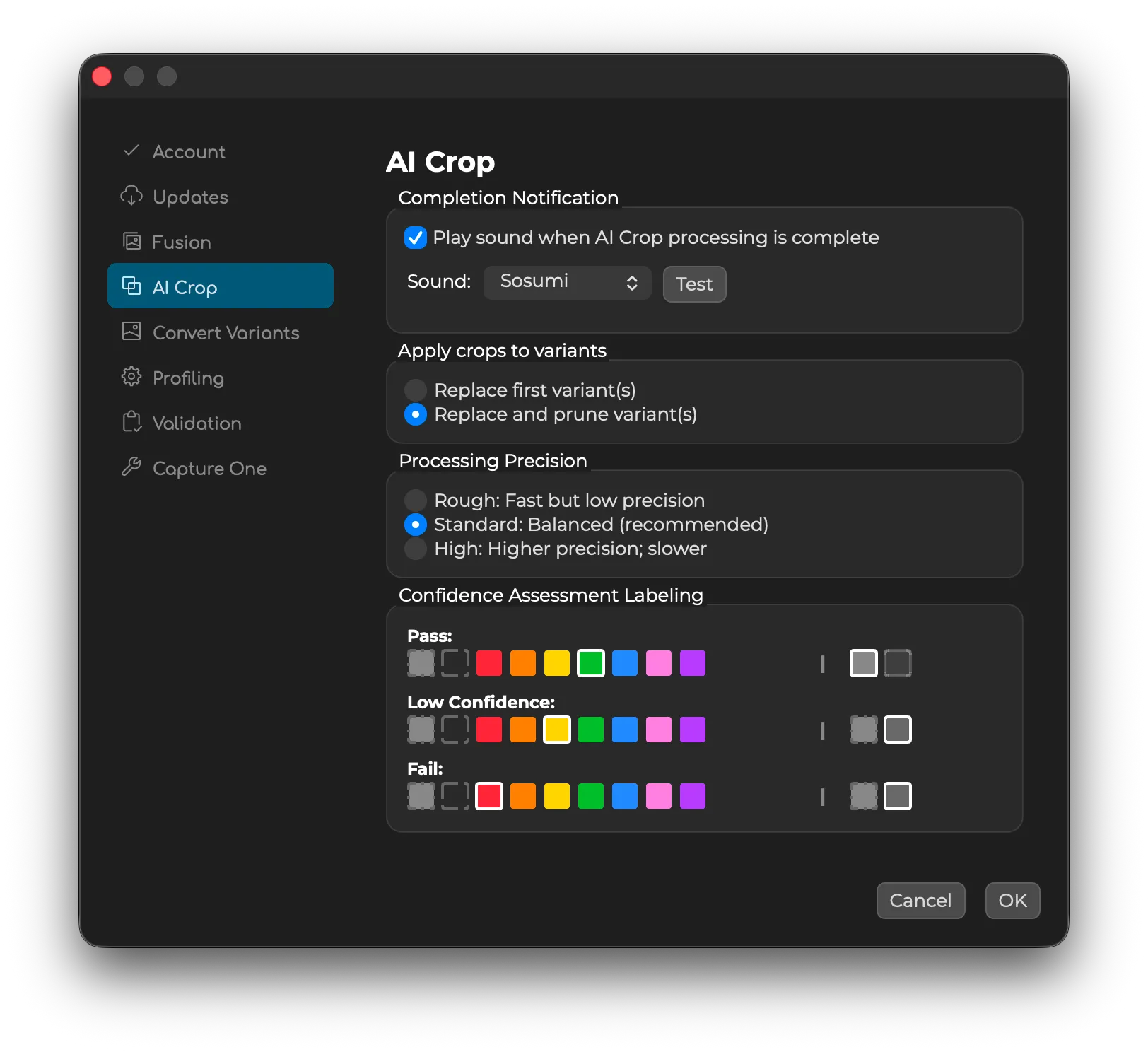
- Replace first variant(s): The result of AI Crop will replace exisiting variant(s) starting with the first. In most cases only the first variant is replaced, but in the case of page-splitting the second variant is also replaced (or a second variant is created if none exists). Since this option leaves existing excess variants in place you can, for example 1) select all 2) run AI Crop with "include target" checked 3) clone variants 4) run AI Crop with "include target" unchecked; this will leave one variant with a target, and one variant without the target.
- Replace and Prune Current Variants: Like Replace first variant(s) but after the output of AI Crop has been created, any additional variants are deleted.
Selecting Variant by Position
At various points in the AI Crop workflow, it can be helpful to know the below tools that allow you to select variants by their position.
In Capture One you can right click on a thumbnail of any particular variant and use the Select By Same > Variant Position to select all images of a particular variant.
To remove all non-first variants you can use Select by Same > Variant Position on a first variant of any image, and then use Command + I (or Select > Invert Selection), and then hit delete.
Confidence Assessment Labeling
- Pass: Variants that AI Crop is confident are correct. Of course, no automatic assessment system is 100% accurate so some bad crops may be labeled "pass".
- Low Confidence. Variants that AI Crop has low confidence in. Some of these may be correct, or may only require minor remediation.
- Fail. Variants that AI Crop could not complete. Reasons could include the file could not be exported (read only), no materials were found, or a bug in the code. Note that if only a target is found, and no object, this will be marked as a failure except in Target Mode.
Based on the above determination the color tag or album assignment of a variant can be changed, allowing the user several ways to quickly QC and remediate the resulting crops.
- Color Tag: One of the color tags can be assigned, the color tag can be cleared (set to None), or can be left alone (Null / no change). Color tags are the most visual and convenient way to flag files for QC purposs.
- Album: The variant can be assigned to an album, or left alone. Album assignment is convenient if you are already using color tags in your workflow (e.g. setting the first page of a new item to blue) and don't want to overwrite them.
Precision
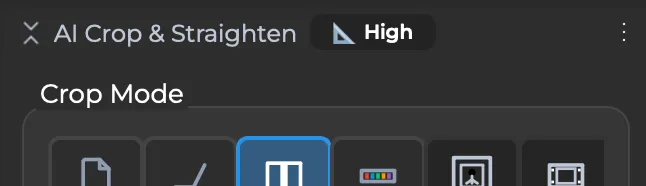
This setting allows you to trade precision for speed. It can also be changed from the AI Crop & Straighten tool in the center of the tool title bar.
Because AI Crop is running a high resolution AI Model it is slower than legacy automatic cropping methods like AutoCrop, especially on older computers.
In general the "Loose" mode will be more precise than the other modes which deal with more complex materials.
In general "include fanning/cover" will have higher precision than excluding them, as AI Crop must find the more delicate edge of the page against the fanning and cover material.
Precision Modes
- Rough: To maximize speed, the model is run at a lower resolution and without certain refining operations. In our testing this mode produces crops that are typically within 45px (assuming a 150mp capture) on each edge, but your results may vary. At 300ppi that is around 4mm (~1/8th inch).
- Normal: Balancing speed and precision, the model is run at intermediate resolution and with some, but not all refining operations. In our testing this model produces crops that are typically within 35px on each edge (assuming a 150mp capture), but your results may vary. At 300ppi that is around 3mm.
- High: To maximize precision the model is run at maximum resolution and with all refining operations turned on. In our testing this mode produces crops that are typically within 25px on each edge (assuming a 150mp capture), but your results may vary. At 300ppi that is around 2mm.
Bad vs Imprecise Crops
The guidance above on the precision of AI Crop in different precision modes assume the model has "seen" the materials correctly. In some cases the AI model does not correclty "see" the materials. For example, the model currently handles modern books with graphical dust covers poorly, seeing the dust cover as part of the page.
Thus AI Crop tends to produce one of two results: A good crop which is within X pixels of the ideal crop based on the precision mode, or a bad crop which can be off by any amount. Changing the Precision Mode will generally not improve the result of a bad crop.