Why Color Negatives Are Different
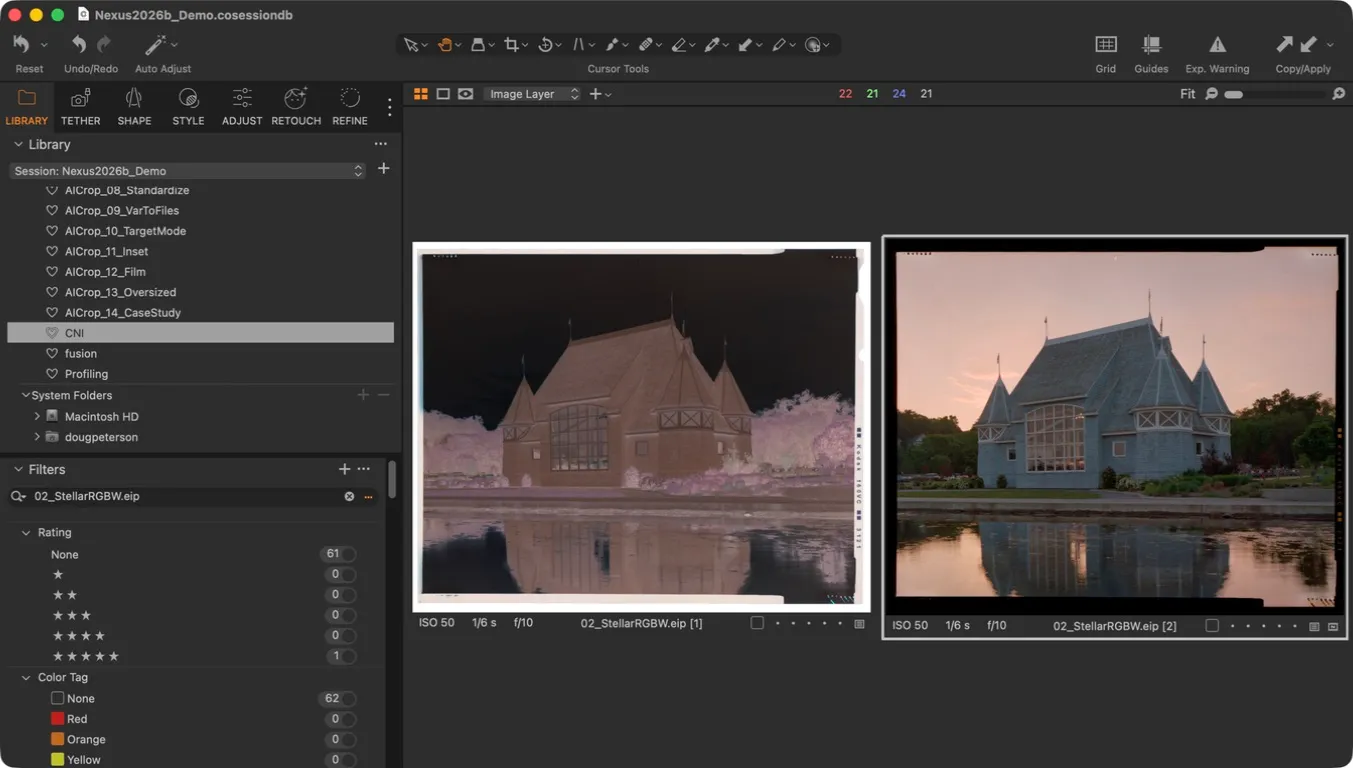
Color Negatives Do Not Directly Encode Color
Color Negatives were never designed to be looked at directly; in technical terms they are not "direct calorimetric encodings". Instead they were designed to be physical spectral filters within a system that included a specific type of enlarger illumination* with specific spectral output, a set of enlarger filters, and photographic paper with specific (and narrow) spectral responses. When captured with a white light and a standard capture the immediate image has reverse polarity (dark content is bright and vice versa) and terribly orangish-brown**.
It is not authentic to the science or historical use of color negatives to capture it in this manner and attempt to reconstruct the intended filmic color by inversion, white balance, and levels or curves. Such methods, or the plugins or features that automate them, can produce okay color, but compared to capturing the film correctly they will always fall short. Such methods rely heavily on the scene itself to guide adjustments and so are inconsistent and do especially poorly with scenes where the brightest or darkest subject are not neutral (e.g. see the sunset image above where the brightest subject is pink and the darkest subject is dark brown).
Capturing Color Negatives Correctly
DT Nexus provides for color negative capture and inversion by controlling and calibrating the entire spectral chain. That is, the spectral output of the light, the spectral response of the camera, and the math of capture and inversion are all designed as one system, and are calibrated on the physical film you are capturing.
This means the native capture itself requires only basic adjustments such as tonal inversion, contrast, and scene-based white balance. The underlying color is being correctly captured.
*The exact illumination changed over the history of color negatives
**Some color negative films had clear or differently colored bases; however, the vast majority of such collections will be brownish-orange.